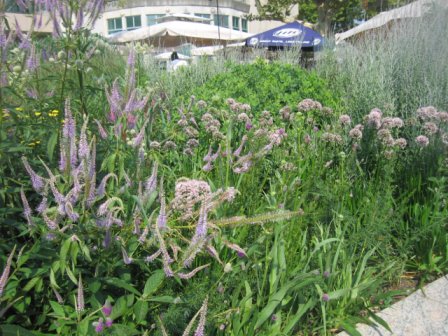
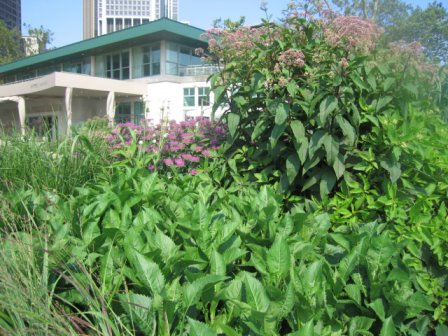
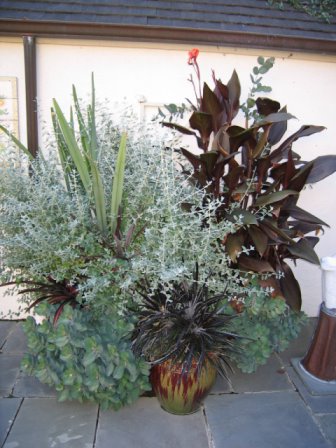
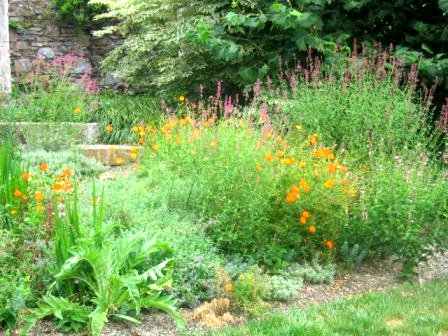
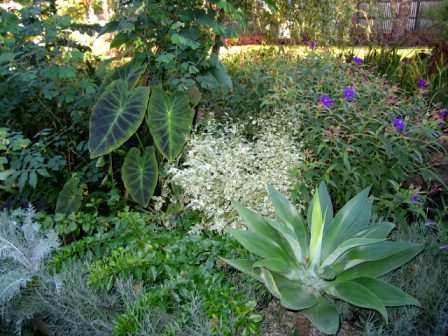
As I have previously written, I am a great fan of Chanticleer. As a part of Gardening Gone Wild’s recent Garden Bloggers’ Design Workshop on Container Gardening, there is a short post with insights from Dan Benarcik, the horticulturalist who designs many of Chanticleer’s inspiring containers. Despite their “over the top couture” appearance, he does try to make their maintenance as simple as possible–planting once for the season, fertilizing once a month, and watering once a day.
Category: Botanical Gardens
How to Prune Roses, Part III: Why Prune?
Every free moment I get now, I’m out pruning roses. This month I am working on my portlands, hybrid perpetuals, hybrid musk, and polyanthas. While I was outside pruning today, my oldest son–my most observant and handy child in the garden–asked me, “Why do you prune them?” What a great question. If we think about why we’re pruning, it will help us to get the most out of the job.
~
Pruning for Size
~ First, I prune to control the size of my roses. One of the criticisms against old roses is that they take up too much space compared to modern ones. Yet, you can grow them as smaller shrubs. The Reeves-Reed Arboretum (http://www.reeves-reedarboretum.org/) in Summit, New Jersey has a great collection of old roses in a small space. I observed that they prune these roses by half each year which keep them to a size of about 3 feet by 3 feet, instead of the usual 5 by 6. In my garden, I grow Russell’s Cottage (http://heirloomgardener.blogspot.com/2007/12/seven-sisters-rose.html, pictured above). It is reported to grow to between 6 to 12 feet high with equal girth. By pruning, I have kept it to about 4 feet tall and 3 feet wide.
~
The key to old shrub roses is accepting that these roses are really tough. They have survived this long because they can regenerate themselves and resist disease. It took awhile, but now I am no longer afraid of cutting them way back. By doing so, I get to enjoy a greater variety of roses in a small space.
~
Pruning for Blooms
~
Second, I prune my repeat bloomers to stimulate growth and better, more continual blooming. The early spring pruning gets rid of thin, unproductive wood in the roses which drain energy away from flower production. The rule of thumb is that you should cut out any growth less than the diameter of a pencil. I also find it helpful to ask myself if the branch could support a rose blossom. If not, then prune it out. Lastly, remember that the stems as they come off the prior branch get smaller and smaller. If there is doubt about rather to keep something or not, ask yourself if the branch which comes off of it is too small to be productive. Very rarely will you regret pruning out questionable wood.
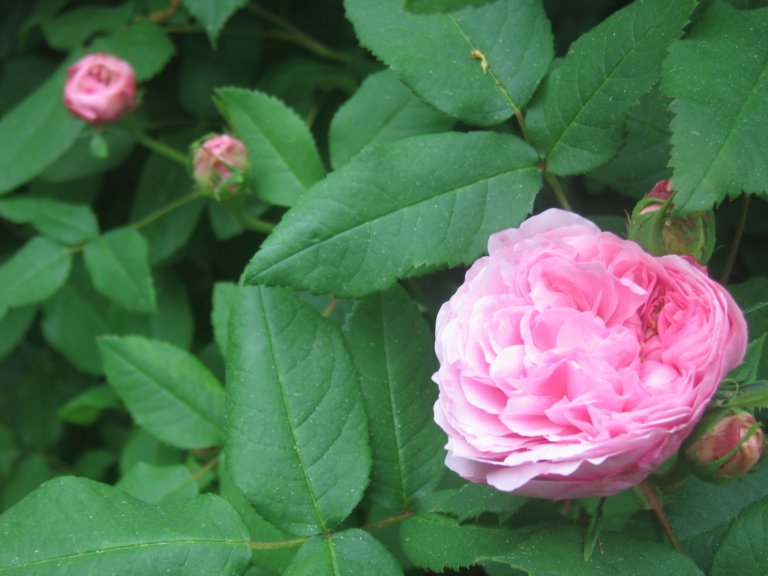
~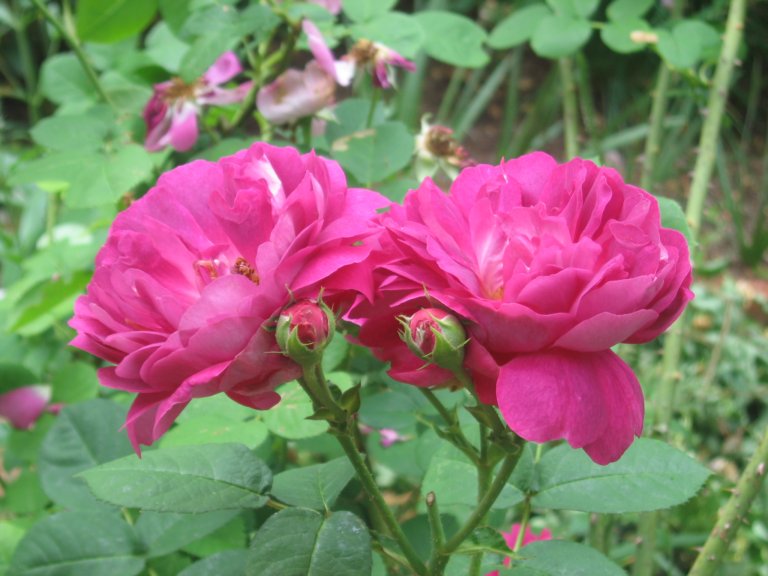 Without needing to sustain the wood you remove, the rose can give more energy to blooming. Oftentimes, if a repeat blooming rose goes a season where the blooming seems less prolific, cutting it back by half will remedy the situation. I find that portlands, in particular, need a firm pruning hand every three to four years. As they get larger, the frequency of their flushes decreases. With lots of young wood, shrubs like Rose de Rescht (http://heirloomgardener.blogspot.com/2007/11/rose-de-rescht.html, pictured above) and Jacques Cartier (a.k.a. Marchesa Boccella, pictured below), will bloom almost continuously from June to October.
~ While removing the unproductive wood, all dead and damaged wood should also be removed. This wood can harbor disease and will take energy away from the shrub. Finally, you can cut away branches that are congesting the center of your shrub. It is good to lighten it up so that air may easily pass through.
~
*****
~
With these two main ideas in mind, my pruning is directed and it’s easier to know what cuts to make: I prune to keep the rose in its allotted space and to direct more of the plant’s energy to make big, beautiful blooms that keep on coming.
~
For “How to Prune Roses, Part I: An Introduction” click here: http://heirloomgardener.blogspot.com/2008/02/how-to-prune-roses-part-i-introduction.html.
~
For “How to Prune Roses, Part II: Old Rose Pruning Secrets” click here:
http://heirloomgardener.blogspot.com/2008/03/how-to-prune-roses-part-ii-old-rose.html.
Inspiration for the Long Border: American Prairie Plants in Battery Park, Designed by Piet Oudolf
I love the plants of the American prairie. The simple forms are beautiful. They are undemanding, attract tons of butterflies, flower over a long period of time, and make me feel connected to the land. Unfortunately, I don’t have the setting and environment where I could create a meadow garden.
In the Long Border, I have tried to incorporate many of these plants–echinacea, black eyed susans, phlox, butterfly weed, goldenrod, joe pye weed, asters, liatris, veronicastrum, monarda, baptisia, rattlesnake master–into my planting.
My inspiration for the Long Border came from a trip I took to the gardens of Battery Park in lower Manhattan. These American prairie plants compose a large part of the palette used by Piet Oudolf, the Dutch garden designer of the park. Below are some of the photographs I took on my visit.
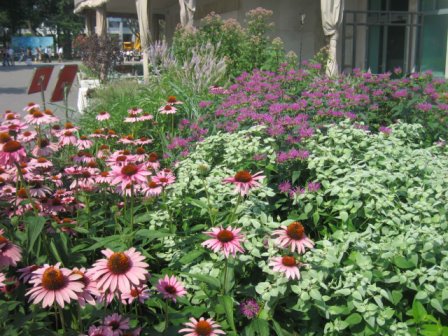 The first picture shows purple coneflower and mountain mint in the foreground, backed by monarda, veronicastrum, joe pye weed, and miscanthus.
 The second photo shows baptisia (not in flower), monarda, and daylilies with a mass of amsonia in the back.
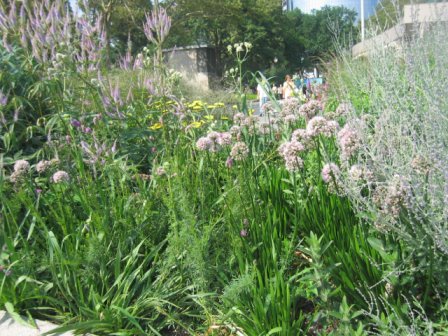 Photo three shows veronicastum, Russian sage, yarrrow, rattlesnake master, and alliums.
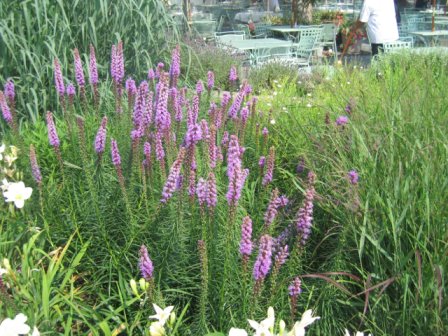 The fourth photo shows liatris and switch grass.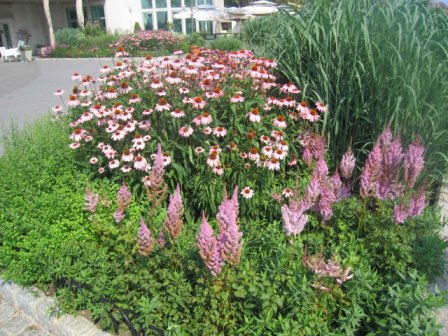
The fifth photo includes purple coneflower, switch grass, astilbe, and oregano.
For pictures of the Long Border, click here: http://heirloomgardener.blogspot.com/2008/01/garden-for-late-summer-long-border.html
For my prior post on Piet Oudolf, click here: http://heirloomgardener.blogspot.com/2008/02/winter-garden-inspiration-piet-oudulf.html
Garden Color: Inspiration from Chanticleer in Wayne, Pennsylvania
 Chanticleer, in Wayne, Pennsylvania, is one of my greatest sources of inspiration as a gardener. It describes itself as ‘America’s pleasure garden’ and that it is. I love Chanticleer because you can tell the staff loves plants and loves to play with them in creative combinations and venues. Everything is done to please and exite the senses.
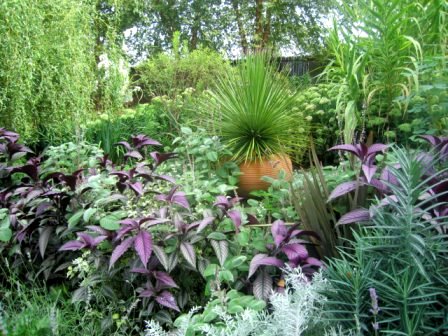 Color at Chanticleer is as much about flowers as it is about foliage. The combination of various leaf colors, textures, and shapes makes the garden interesting without any thought to flowers.
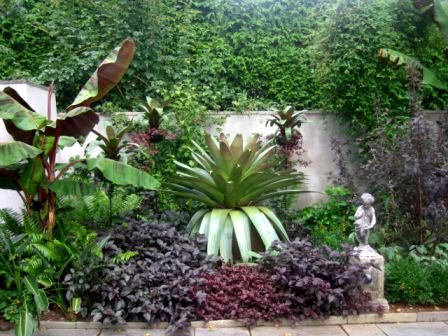 Purple leafed plants run as a theme through Chanticleer. I love how dark leaves interact with light and add a deep rich beauty which soothes the mind rather than excites.
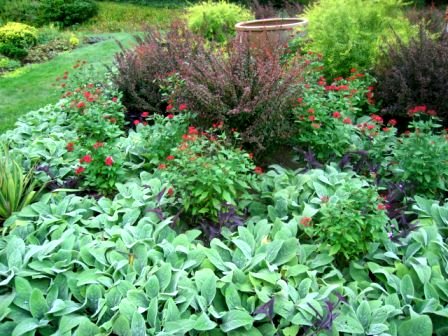 Over the last several years of viewing Chanticleer, I have added two smokebushes (Cotinus ‘Grace’ and ‘Royal Purple’), Rose glauca, purple phormiums, dark leafed clematis like ‘Freda’, amaranthus ‘Hopi Red Dye’ to my garden. The dark color relieves the green and really brings out any silver toned plants nearby. Also, the purple foliage looks great in floral arrangements.
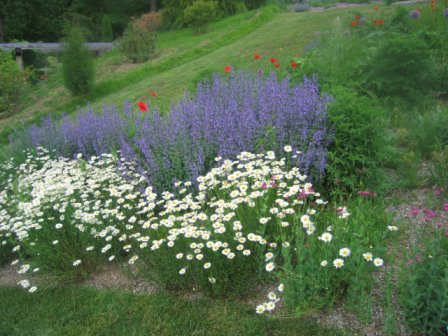
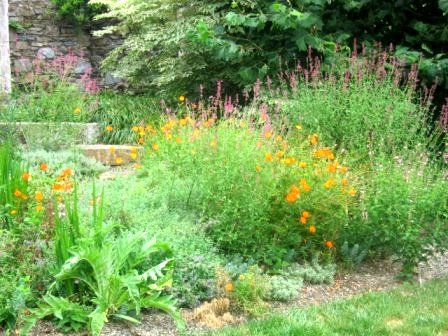
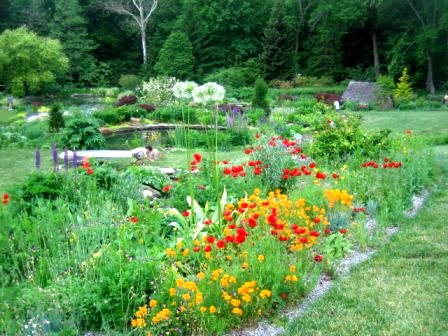 One of my favorite quotations from Christopher Lloyd as it regards planting and border design is that “you should never have to explain what you were trying to do.” At Chanticleer, this rings true. All the plantings are dense, rich, and full. The feeling of abundance surrounds you. There is rarely one of anything. Instead, it’s large swaths of poppies set against orange wallflowers.
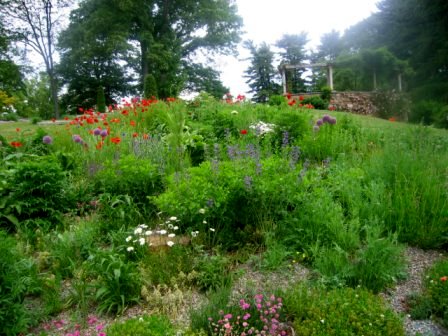 My garden is my small piece of Eden where I can experience this. This year I want to do a combination of yellow anthemis and orange butterfly weed. I know from Chanticleer I’ll want to plant more than I think of both.
  For more information about Chanticleer, click here: http://www.chanticleergarden.org/
  This post was inspired by the “Garden Bloggers’ Design Workshop – Colors in the Garden” at one of my favorite gardening blogs, Gardening Gone Wild: http://www.gardeninggonewild.com/?p=698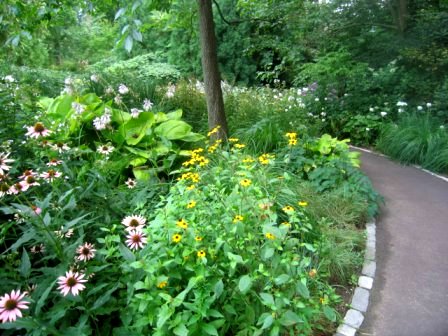
Living and Gardening Around Chatham, New Jersey
When non-gardening people move, they ask easy-to-answer questions such as, how are the local schools? For gardening people, moving is much more complicated by questions such as, how are the local nurseries?
In brief, Chatham, New Jersey and nearby commuter towns (such as Maplewood, Millburn, Short Hills, Summit, Green Village, Madison, Morristown, New Providence, and Berkley Heights) are great places for gardeners. I recently visited my father in another community and noticed how few nurseries were present. Further, while the homes and the community were attractive, I didn’t drive by any home gardens that made me want to stop my car and take a second look. This made me appreciate all of the great gardening resources that I have at home.
For those who are nearby and/or for those gardeners who are thinking of moving here, here’s the lay of the land:
1. Plant Nurseries Around Chatham, New Jersey
The Farm at Green Village (Green Village)
Great Swamp Greenhouses (Gillette)
J & M Home & Garden (Madison)
2. Gardening Resources Around Chatham, New Jersey
S. Johnson Landscape Management (Chatham)
Garden Cottage – Patio Furniture (Morristown)
The Birdhouse at Madison (Madison)
Dreyer’s Lumber (Chatham)
Savatree Arborists
3. Farmers’ Markets Around Chatham, New Jersey
Chatham Farmers’ Market (Chatham)
Summit Farmers’ Market (Summit)
4. Botanical Gardens Around Chatham, New Jersey
Reeves-Reed Arboretum (Summit)
Willowwood Arboretum (Chester Township)
Presby Memorial Iris Gardens (Montclair)
5. Other Outdoor Spaces Around Chatham, New Jersey
Fosterfields Living Historical Farm (Morristown)
Great Swamp Outdoor Education Center (Chatham)
Noe Pond Club (Chatham)
The Raptor Trust (Gillette)
Morris County Parks Commission (Morris County)
New Jersey Tourism: Gardens (New Jersey)
6. Non-Gardening Information About Chatham, New Jersey
Chatham Borough
Chatham Recreation
Chatham Township
Money Magazine Best Places To Live 2005
NJ Transit – Commuting to Chatham
School District of the Chathams
*****
March 2008 Update: Chatham Township was named the best place to live by New Jersey Monthly
The Garden Conservancy: Preserving Exceptional American Gardens
For inspiration, I regularly visit public gardens with my family during the gardening season. I just found out about the Garden Conservancy, “a national, nonprofit organization founded in 1989 to preserve exceptional American gardens for public education and enjoyment.”
The Garden Conservancy currently supports the preservation of gardens across the country, including the following that appear to be within driving distance of Chatham, New Jersey:
Greenwood Gardens Short Hills, NJ
Hollister House Washington, CT
Rocky Hills Mount Kisco, NY
Steepletop Austerlitz, NY
Van Vleck House & Gardens Montclair, NJ
For more information about the Garden Conservancy, click here:
Brooklyn: Private and Public Gardens
I was bitten by the gardening bug when I lived in Brooklyn Heights. Brooklyn Heights is a wonderful neighborhood next to the Brooklyn Bridge across the river from lower Manhattan. It is mostly made up of four to five story brownstones, many of which have front and/or back yards. As you get to know people in the neighborhood, they invite you into their homes and–in the warmer months–their private gardens. In the big city, these are private respites, small green spaces full of beautiful plants, and the perfect place to entertain. If you are not fortunate enough to have friends in the neighborhood, there are several public gardens that will give you a feel for what is behind the brownstones.
These are not formal Botanical Gardens, but rather green public spaces that are integral to their neighborhoods. Here are some suggestions:
*Brooklyn Heights Promenade (a great playground, as well as a tourist attraction for the view of Manhattan) – Brooklyn Heights
*Carroll Park (a neighborhood park with a playground and sprinklers in the summer months) – Carroll Gardens
*Cobble Hill Park (another neighborhood park with a small playground and a great Halloween parade for children) – Cobble Hill
In addition to the aforementioned, these two spaces are not public, but you could certainly visit them if visiting the church or buying a cup of coffee:
*Oratory Church of St. Boniface (the enclosed garden is sublime) – Downtown Brooklyn
*Sweet Melissa Patisserie (eat in the garden out back) – Cobble Hill
 Heirloom Gardener