
Renegade Gardener is a gardener after my own heart. He lives “in Minnesota, a state crisscrossed by USDA Hardiness Zones often given short shrift by national gardening books and magazines.” His 10 Tenets are funny and full of heard-earned gardening wisdom (http://www.renegadegardener.com/content/ttenets.htm). They make me ask myself: how can I replace the grass on the hill in my backyard? should I cut down the oak tree in the front? how can I start thinking of September as a summer month?
Plant Delights Nursery & Heirloom Hostas
January. Oh, sweet January. Finally, the catalogs come. I love gardening catalogs not only to see if some plant on my most wanted list is available, but also for all the information. My favorite garden catalog and website is that of Plant Delights Nursery in Raleigh, North Carolina (http://www.plantdelights.com/). The nursery specializes in perennials and has a particularly large selection of hostas. The website is a gold mine of information. The descriptions of the plants are full and give great information about heat and humidity tolerance as well as what are the plant’s tendencies–a spreader or stay putter. The catalog is so informative because they do a lot of research and testing themselves.
They are also able to offer many hard to find plants because of their relationships with other plantsmen and propagation efforts. They make available many plants that are difficult to propagate or are time consuming to grow. All plants are grown in containers which helps ease their transition into the garden.
Also, on the website you can find horticultural articles. Last August, I ran across an amazingly fragrant, double hosta at Willowwood Arboretum in Chester Township, New Jersey (http://www.parks.morris.nj.us/aspparks/wwmain.asp). On the Plant Delights website I found a great article on fragrant hostas which discussed their history and identified named, fragrant cultivars.
The proof in the pudding comes in the spring when you receive your shipment of plants. Plant Delights sends out good sized, healthy plants that have been packed with a lot of care. Every plant I’ve ordered from them has had no problem settling into the garden, even the new ones that were damaged from the fallen oak tree clean up appeared the next year even more robust.
The Garden Conservancy: Preserving Exceptional American Gardens
For inspiration, I regularly visit public gardens with my family during the gardening season. I just found out about the Garden Conservancy, “a national, nonprofit organization founded in 1989 to preserve exceptional American gardens for public education and enjoyment.”
The Garden Conservancy currently supports the preservation of gardens across the country, including the following that appear to be within driving distance of Chatham, New Jersey:
Greenwood Gardens Short Hills, NJ
Hollister House Washington, CT
Rocky Hills Mount Kisco, NY
Steepletop Austerlitz, NY
Van Vleck House & Gardens Montclair, NJ
For more information about the Garden Conservancy, click here:
Salve for the Gardener’s Winter Blues: How to Grow Amaryllis
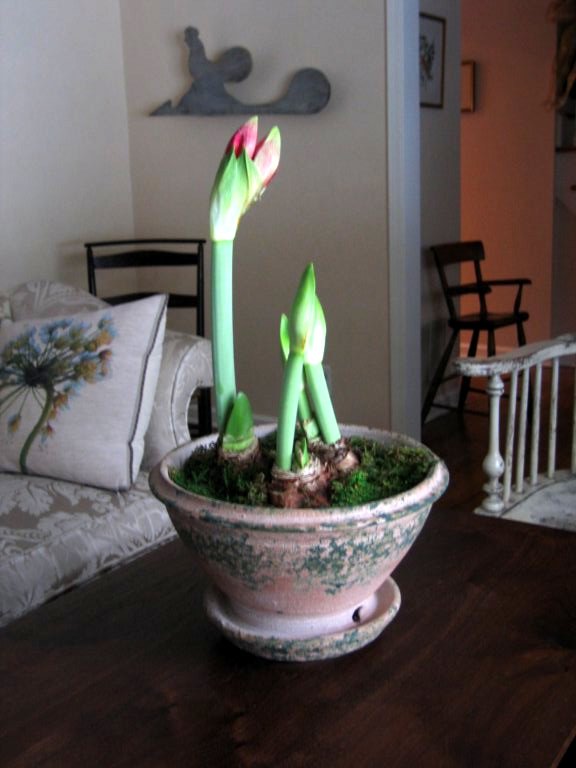 As any gardener will tell you, winter is an excruciatingly long season. Trapped in our homes with no active gardening to be done, we plan the next season’s gardening projects and count down the days until the glorious spring days arrive and we can get our hands dirty.
Ready to be planted and pre-planted Amaryllis bulbs are readily available–I’ve even seen them sold at Target and the local grocery store. For a broader selection, I purchase my Amaryllis bulbs from:
I purchase them in September, as some types sell out by October. As you can see in the picture, they start to bloom around Christmas.
If you buy ready to be planted bulbs, they can be placed in shallow pots with the tops exposed. I cover the exposed soil with moss to enhance the pot’s appearance. Over the next couple of months, it is pleasing to watch the Amaryllis grow and flower. Each stem produces three to four blossoms.
After the flowers have bloomed, I dispose of the bulbs. By this time, the other bulbs that I have chilled–daffodils, hyacinth, tulips–will be ready to replace the spent Amaryllis.
While it is possible to keep your Amaryllis bulbs so that they flower the next season, I neither have the space nor the time to do this once spring arrives.
For a prior post on forcing bulbs and branches, see:
http://heirloomgardener.blogspot.com/2006/02/forcing-forsythia-and-bulbs-of-all.html
Q. What Do You Do With Rocky Soil? A. Make Dry Laid Walls
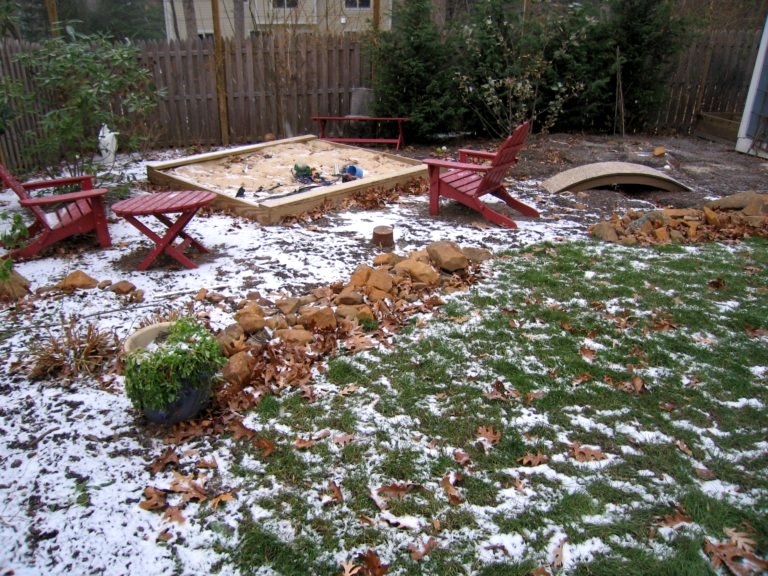 In honor of Gardening Gone Wild’s Design Workshop on fences and walls, here is a post about a rock “wall” my husband and I created.
In a prior post, I wrote about the disaster which befell us two summers ago when one of our oak trees fell after a storm and the tulip tree growing with it had to be removed subsequently:
This event not only ruined the shade garden I just planted, but also unearthed more rocks than you could believe. Further, the heavy machinery in and out of our backyard compacted the earth and made even more rocks visible on the surface. I always knew my property was rocky seeing that each time I dig a hole I come up with more rocks. But, what to do with so many rocks at one time?
In preparation of redesigning our backyard, I sketched on graph paper the outline of a central lawn bordered by different gardens and play areas for the children. Before finalizing the plan and laying the new top soil and grass seed for the lawn, we used the rocks to demarcate the future lawn and garden areas. It always helps me to transfer my plan on paper to the ground and adjust the plan according to what looks best.
Once we finalized these lines, we decided to relocate all of the now visible rocks from the tree and lawn areas for the safety and comfort of running and walking barefoot. It was at this stage that we decided to make the “wall” that provided a name for the Walled Garden.
We followed none of the rules of laying a dry laid wall, but simply stacked the rocks together in a line. It’s not as beautiful as New England’s dry laid walls, but its primitive appearance fits with the rest of our garden. All of the rocks have the distinctive orange coloring of all of the iron-rich earth in Chatham, New Jersey and the surrounding area.
For more on Gardening Gone Wild’s Design Workshop, click here:
You Grow Girl Blog: Plant-Related Christmas Gift Ideas You Can Make
This is a great post about gifts you can make from your garden:
Q: How Do You Keep Deer Out Of The Backyard? A: The Deer Fence
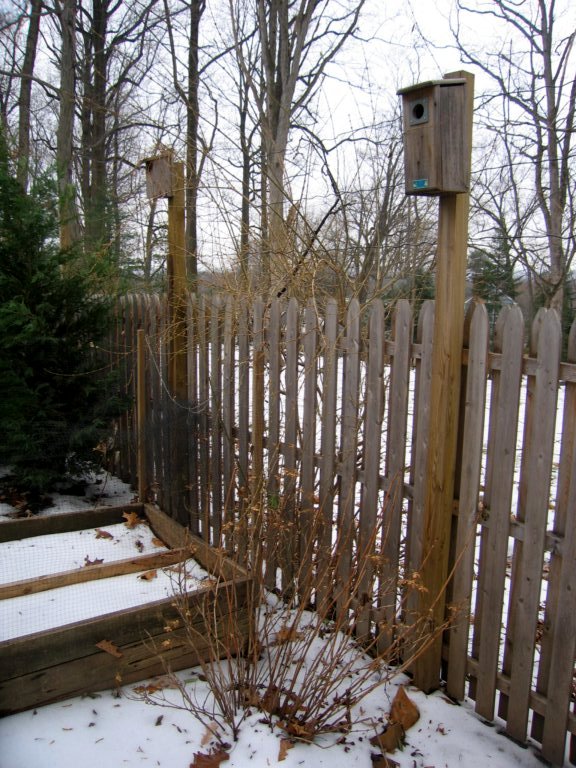 Chatham, New Jersey is overrun by deer. It is not uncommon to see shameless groups of deer grazing in our neighbors’ yards or strolling down the street. The first victims are the deer’s favorites–like ewe hedges, hostas and hydrangeas. By the end of the season, their appetite expands to include some of the deer resistant plants (so called by our local nursery), such as cone flowers and shasta daisies.
In order to keep the deer out of our backyard, we have installed a six foot tall wooden fence. For added protection, the fence posts (four by fours) are ten feet tall and strung with very strong, weather-resistant, plastic-coated wiring. There are three rows of wire above the fence, each spaced about one foot apart.
Aesthetically, the wiring is virtually invisible from a distance and does not take away from the beauty of the garden as some traditional deer fences do. In addition, we have topped many of the posts with bird houses.
Cold Climate Gardening Blog: Why Aren’t There More Younger Gardeners?
As a relatively new gardener (age 35), I found the following discussion over on Cold Climate Gardening of interest:
http://www.coldclimategardening.com/2007/12/14/why-arent-there-more-younger-gardeners/
Common Witchhazel Blooming in December
When driving to my friend P’s house (also in Chatham, New Jersey), I almost ran off the road when I noticed  Common Witchhazel (Hamamelis virginiana) in full bloom. I’d never noticed it before, as it is a small tree in the corner of her yard–but now that it’s in bloom, you can’t miss it.
My friend P was kind enough to give me a branch that came off during the recent ice storm to enjoy indoors.
From this branch, I have taken a few small cuttings and put them in the refrigerator, so I can try to propagate them in the spring. If I can’t, I’ll have to find one to mail order.
 Heirloom Gardener